Posts

Showing posts with the label cisco

VXLAN Journey - Part 01 - What is VXLAN and how it works (Cisco Nexus Switch) - Basic data plane learning

Image
For several years I have worked with Data-Center network based on VXLAN. Anyone suddenly start working with production DC-networks built on top VXLAN - with Spine-Leaf topology and Multi-Site - they will get lost easily. Also lack of good step by step written books from the vendors Cisco, Arista, Juniper etc. make it difficult to understand the technologies/protocols used for VXLAN in DC-network.  Let's try to solve the problem - by building a DC-network from scratch and step by step using Cisco Nexus switches. What is VXLAN? The most common answer is - tunnelling a layer-2 packets over layer-3 network. I define it another way - the whole DC is a fabric. A fabric consists of several switches. With VXLAN, the whole DC-Fabric becomes a single switch (of course - logically). We are eliminating three fundamental problems in DC -  The network core becomes Spanning Tree Protocol (STP) free. All the physical links in the core are used Equal-cost multi-path routing (ECMP). The network...
Configuring Cisco Embedded Event Manager (EEM) - Programming IOS

Image
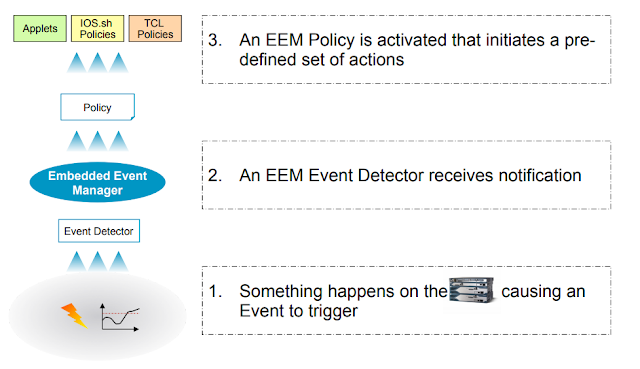
In today's network; everyone tries to automate as much as possible. I will cover one such topic today - EEM (Embedded Event Manager) in Cisco devices. EEM is supported by Cisco IOS, XR and NX-OS. EEM allows automation for Cisco device administrators by tracking and monitoring events in network devices and take actions when those events occur. For example; we want to shutdown an network interface at a scheduled time, change interface description when new LLDP neighbors are detected, backup device configuration etc. Overview of EEM (Embedded Event Manager) EEM - we need to understand two topics: EEM event detectors - We use event detector to subscribe to an event; for example - interface went down, routing neighbor is lost etc. When such an event is occurred; we will do some automated actions. EEM actions - When an EEM event occurs; we will do some predefined tasks automatically; these are called EEM actions. For example; send an email alert when an interface down event is detected...